Can beginners cycle Sa Calobra?
Honestly, it depends on what "beginner" means. The descent from Coll dels Reis down to Sa Calobra is 9.5 km of continuous hairpins — fine if you have solid braking technique and comfort handling a road bike on technical descents, a real challenge if not. The climb back up is 9.5 km at 7% average, with the last 2 km tightening to around 8% and a brief spike near 11% close to the top. Any cyclist who can ride 40 km on rolling terrain can finish it, but it takes time, the right gearing, and a bit of humility on pace. It's not a ride for a total first-timer.
Last verified: 22 April 2026.
What "beginner" means for this climb
Sa Calobra is consistently described as "the most iconic climb in Mallorca". That reputation brings a lot of cyclists to it who are not quite ready. Before you commit, check honestly against this list:
- Comfortable riding 40–60 km in a day on rolling terrain.
- Comfortable on a road bike descending through hairpins — you can brake smoothly, hold a line, and not panic when a coach comes round a corner.
- Have gearing that lets you climb 7% for an hour at your own pace. A compact 50/34 with a 32- or 34-tooth cassette is a realistic minimum.
- Comfortable being passed by faster cyclists and not racing them.
If all four are yes, Sa Calobra is demanding but completable. If you're weak on the descending point specifically, seriously consider skipping the descent (see "Bail-out" below) and just riding to Coll dels Reis and back. That's still a proper day out and cuts the most technical risk.
The descent: 9.5 km of hairpins
You don't climb up Sa Calobra to start — you descend. The road ends at the tiny village of Sa Calobra on the coast, and the only way in or out (other than by boat) is the road. So every cyclist does the descent first, then climbs back up.
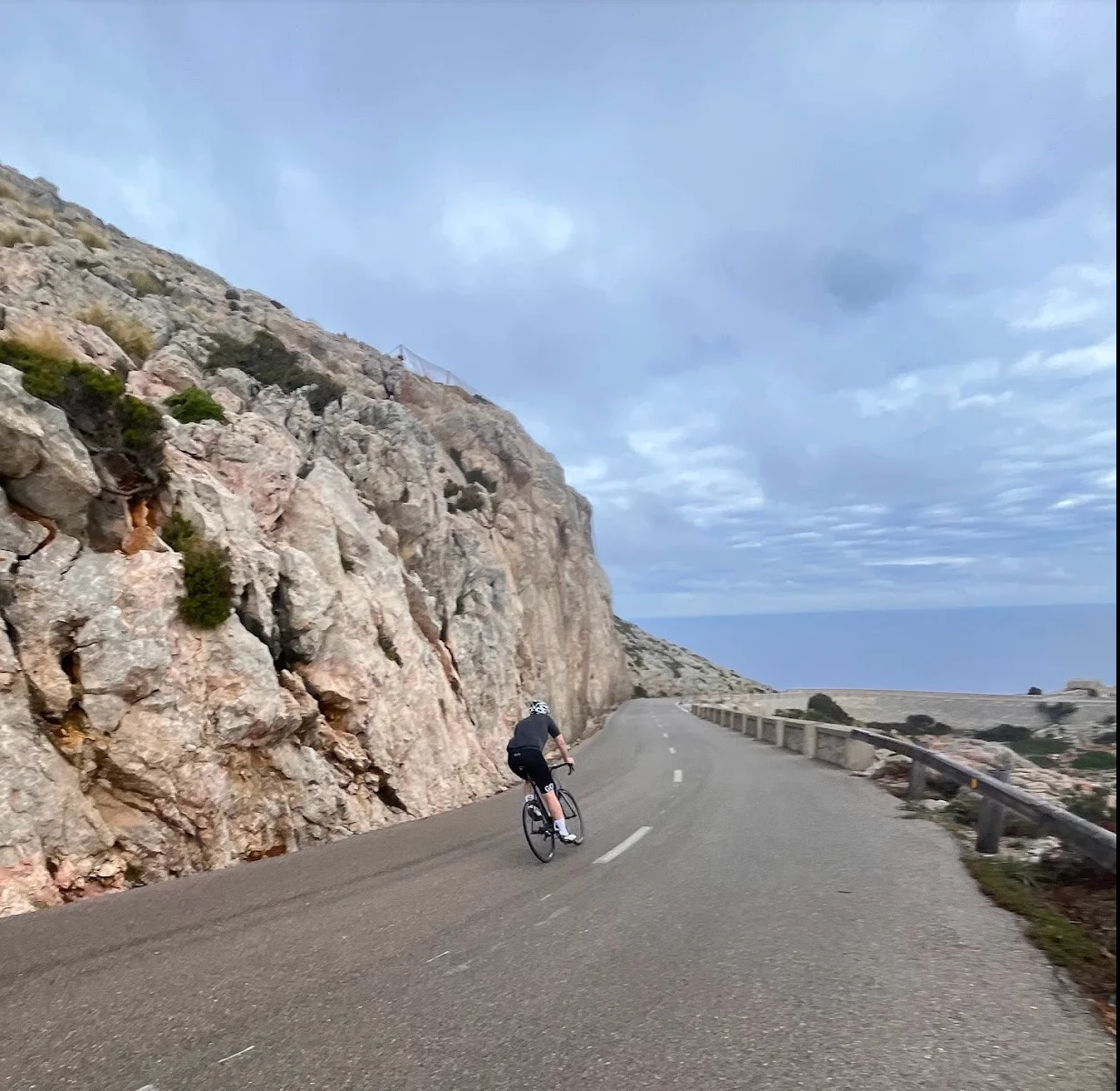
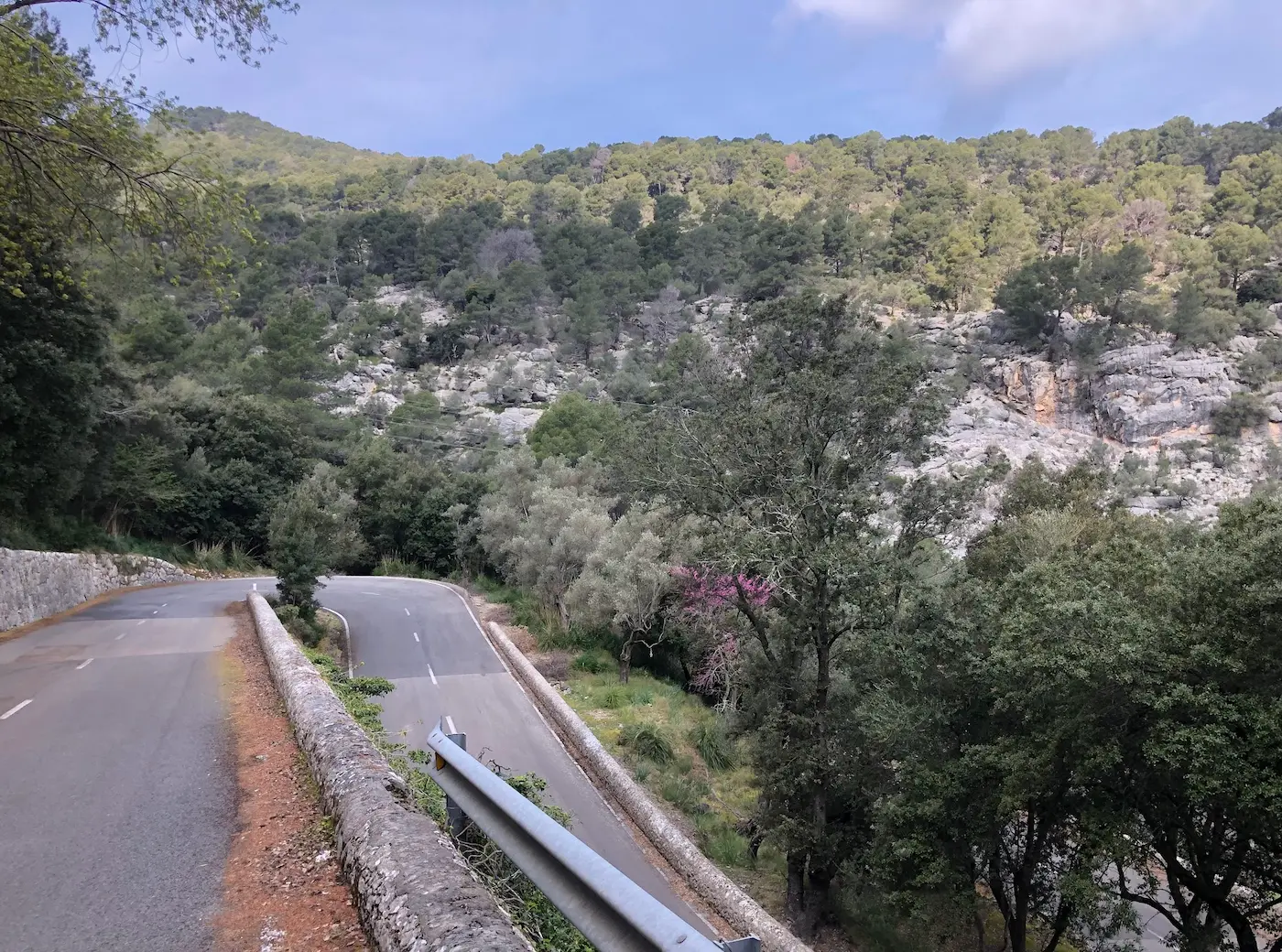
The descent is 9.5 km of continuous switchbacks. The surface is good, the road is wide enough to fit a coach and a cyclist, and the hairpins are well-banked. But the combination of length, tourist car traffic, and the signature Nus de sa Corbata — the 270-degree spiral bridge that crosses under itself near the top — makes it demanding even for experienced descenders. Go slowly on the first run. You'll still be moving faster than any car.
The climb back: 9.5 km at 7%
The climb back from Sa Calobra to Coll dels Reis covers the same 9.5 km you just descended. Average gradient is 7%. The opening 6 km is steady but manageable — a rhythm climb, not a struggle. The last 2 km is the hard part: gradient tightens to around 8% average with a brief spike near 11% close to the top, the hairpins come thick and fast, and the Nus de sa Corbata reveals itself above you as a teaser for the final kilometres.
Expected time for a fit recreational cyclist: 50 minutes to 1 hour 15 minutes. For a beginner at the lower end of the fitness band: 1 hour 15 to 1 hour 45 minutes. Take it at your own pace. Faster cyclists will pass you — that's fine, it's not a race. Drink, eat, and keep moving.
From our ride: Tommy on Sa Calobra
I've ridden Sa Calobra and I loved the climb — the switchbacks and hairpins suit how I like to ride. But the one thing I'd genuinely warn beginners about is the descent. I came around a bend at a normal pace and suddenly hit a full traffic jam: cars stopped bumper-to-bumper because of a coach blocking a hairpin. It happens. If you're not ready to brake hard and stop quickly, that's where you get in trouble.
On the climb back, my advice is simple: find your own pace and rhythm and stick to it. Don't try to match anyone else. The climb rewards steady effort — once you settle into it, the hairpins come one at a time and the views keep unfolding. It's a climb that earns its reputation.
Bail-out: if the descent looks too technical
There is one legitimate option for a nervous beginner: ride up to Coll dels Reis from the other side — coming from Pollença via the Coll de Sa Batalla — look down at Sa Calobra, and turn around without descending. You still get the climb through Sa Batalla and the approach to Coll dels Reis (plus the views over the coast from the top), without the technical descent.
A second option: take the shuttle. There are cycling shuttle services in Pollença and Port de Pollença that will drive you and your bike back up from Sa Calobra village if you'd rather skip the climb back. Not what most cyclists come for, but a valid option if something goes wrong mid-ride.
Finally: don't go alone if you're unsure. Ride Sa Calobra with someone who has done it before, in the early morning before the coach traffic builds up. First coaches typically arrive around 10:00 — be through the descent by 9:30 and you'll have the road mostly to yourself.
Planning your ride
Start early
Leave your base by 8:00 at the latest if you're starting from Pollença or Alcúdia. That puts you at Coll dels Reis by 9:00–9:15 and through the descent before the coaches. After 10:00 the traffic becomes significantly heavier and the descent genuinely hazardous.
Gearing
Compact 50/34 with an 11-32 cassette is the minimum I'd recommend. 11-34 is better. Sub-compact (48/32) is even better if you have it. Don't arrive with a 53/39 and 11-28 unless you are genuinely strong on long climbs — you will regret it on the last 3 km.
Water and food
Sa Calobra village has a couple of restaurants at the bottom — a logical stop for coffee and a sandwich before the climb back. Coll dels Reis at the top also has a small café. Carry two full bottles and something to eat. The climb takes an hour, and in summer heat you will need both.
What to avoid
Don't descend in the rain — the road is narrow and the hairpins get slippery. Don't ride mid-afternoon in summer — the heat plus the coach traffic is a bad combination. Don't try to ride this as your first mountain climb of the trip; do at least one proper climb (Puig Major, Sa Batalla) first to calibrate your legs.
Frequently asked questions
How long does it take to cycle Sa Calobra?
The climb back from Sa Calobra village to Coll dels Reis takes 50 minutes to 1 hour 15 for a fit recreational cyclist, and up to 1 hour 45 for a beginner. Add 30–40 minutes for the descent, plus a stop at the bottom. Total time for the Sa Calobra leg alone: 2–3 hours. Add to that the ride from your base to Coll dels Reis and back.
What gearing do I need for Sa Calobra?
Compact 50/34 with 11-32 at minimum. 11-34 or sub-compact 48/32 is more comfortable. The last 2 km tighten to around 8% with a brief spike near 11% close to the top, so an easy gear matters. Avoid standard 53/39 and 11-28 unless you're strong on long climbs.
Is Sa Calobra safe for beginners?
Safe in the sense that the road is well-paved and the hairpins are well-banked, but the descent requires confident braking and handling. The climb itself is a matter of pacing, not technical skill. The real risk for beginners is the descent combined with tour coach traffic in mid-morning and afternoon. Start early and descend slowly.
Can I take a taxi back up Sa Calobra?
Yes — taxis and cycling shuttle services run from Sa Calobra village back up to Coll dels Reis. Expect to pay around 30–50 EUR for a taxi with a bike, or book ahead with a cycling-focused shuttle operator in Pollença or Port de Pollença. Not the heroic option, but a genuine safety net if you need it.
What time do the tour coaches arrive at Sa Calobra?
First coaches arrive at Sa Calobra village from around 10:00 onwards, with peak traffic between 11:00 and 15:00. If you want the descent largely to yourself, be at Coll dels Reis by 9:00 and start descending immediately. By the time coaches are on the road, you should already be through and starting the climb back.
Do I need to ride Sa Calobra to "do" Mallorca?
No. Sa Calobra is iconic, but Puig Major, Sa Batalla, Cap de Formentor, Coll de Femenia and Coll de Sóller are all world-class climbs with less technical descents and less tourist traffic. If Sa Calobra intimidates you, skip it and ride the others. You will not miss out on the essential Mallorca cycling experience.