When does Valdresflya open?
Valdresflya (FV51), the high-plateau road between Beitostølen and Vågå, was winter-closed on 27 December 2025 and reopens for Easter 2026 (around 4 April). Night closure 20:00–08:00 runs from 30 March until 14 May. The road is typically passable from April to mid-December — reliable cycling conditions begin once the night closure ends in mid-May.
Last verified: 19 October 2026.
Opening pattern year by year
Valdresflya is a National Tourist Route across one of the highest permanent roads in Northern Europe. Unlike Sognefjellet or Trollstigen, which are later-opening mountain passes, Valdresflya typically opens around Easter and stays passable deep into the autumn. Night closures in the shoulder seasons are standard practice — drifting snow in the dark on an exposed plateau is the controlling hazard, not the road surface itself.
| Year | Opening | Note |
|---|---|---|
| 2026 | Easter (around 4 April) | Night closure 20:00–08:00 from 30 March to 14 May |
| 2025 | Easter | Closed 27 Dec 2025 for winter |
| 2024 | Easter | Normal winter |
| 2023 | Easter | Typical pattern |
Source: Innlandet fylkeskommune, Nasjonale Turistveger. Closure and reopening dates are published each season by the county; the pattern is remarkably consistent year-on-year.
Autumn 2026: roadworks on Fv51 run from 25 August to 30 October, with a 50 km/h limit and light-controlled single-lane sections. The road stays open — expect a short wait at the lights and give the works traffic room. Source: Statens Vegvesen road messages, read 21 September 2026.
Why the night closure matters for cyclists
The plateau sits at 1,389 metres with no tree cover and no windbreak for long stretches. During spring nights, loose snow drifts across the road in minutes. The county closes the gates from 20:00 to 08:00 for vehicle safety, but for cyclists the implication is practical: if you roll up to a closed gate at 19:50 you might clear it; at 20:01 you will not. Plan starts early enough that the whole ride happens inside the daylight window.
Night closures lift around 14 May each year. From that point the road is fully open for summer, and it stays that way until the first serious snowfall in late November or December.
From our ride over Valdresflya
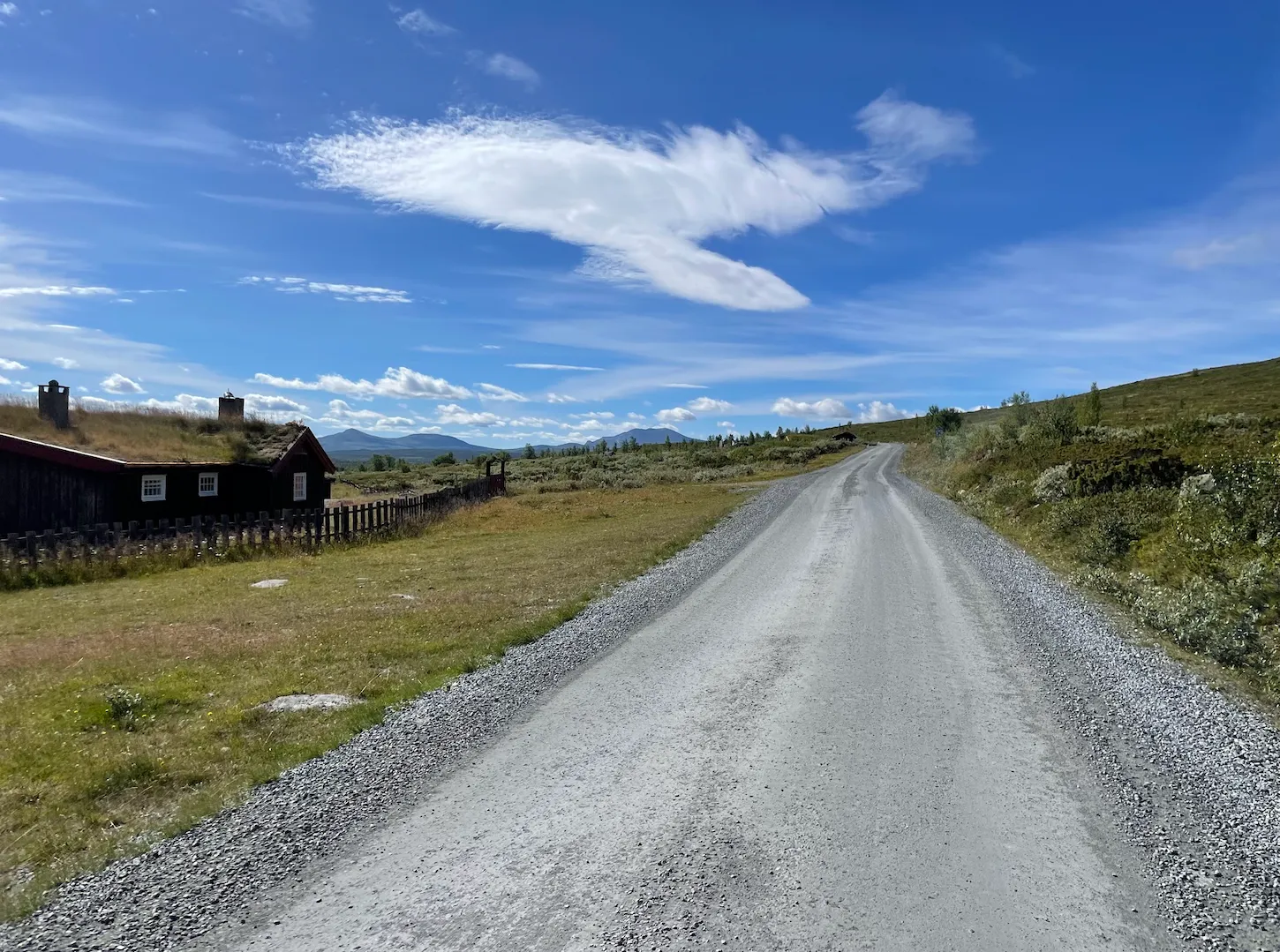
I rode Valdresflya from Beitostølen in August 2022 in beautiful weather. What struck me was how quiet it was. The road is wide, the surface is good, and even on a warm summer weekend there was almost no traffic on the plateau — just the occasional motorhome and a handful of cars. For a National Tourist Route in peak season, that's unusual.
The climb from Beitostølen is gentle — a long, steady rise into open fjell. Birch forest gives way to dwarf pines, then to tundra, then to the bare rock and water of the plateau itself. You are above the tree line for a long time. In August there was no snow, but the lakes were still cold enough to feel the chill off them as you passed.
Compared to Sognefjellet and Trollstigen, Valdresflya is the calm one. Less drama, more silence. That's its character. Go for it on a day when you want space, not spectacle.
Planning your ride
Best time to ride
Mid-May to October is the reliable window. Before the night closure lifts on 14 May, any evening plan is a gamble. After late October, cold temperatures and early snow become realistic on the plateau. July and August are warmest and quietest on the road.
Which direction to ride?
From Beitostølen northbound is the classic direction — you climb gently out of the Valdres valley, reach the plateau, and descend into Gudbrandsdalen via Vågåmo. The return can be done by shuttle or the same road the next day. Riding north-to-south is equally valid; the gradients are gentle enough that neither direction is obviously harder.
Gearing
Not the reason you came. The climb from Beitostølen averages well under 2% across 25 km. A compact chainset with a 28-tooth cog is more than enough. The effort comes from distance and wind, not gradient.
Food and water
Beitostølen has full service — cafés, shops, hotels. The plateau itself has very little: Valdresflya Vandrarheim near the summit is a useful stop if it's open (check seasons), and there are a couple of small service points on the Vågå side. Carry enough water for 3–4 hours of riding in case the wind picks up.
Wind and weather
The plateau is exposed. On still days it is a cruise; on windy days it is a wall. Check the forecast and be willing to flip direction or reschedule if the wind is bad — a 40 km headwind across open fjell is a different ride entirely. Afternoons are often calmer than mornings in stable summer weather.
Traffic
Low, even in summer. Valdresflya does not have the coach-tour tourism of Trollstigen or the Easter-weekend rush of Sognefjellet's opening. You will share the road with motorhomes and a few cars, but large stretches are empty.
Is Valdresflya a good early-season ride?
Technically yes, practically only with caveats. The road reopens at Easter, which puts it a full six weeks ahead of Sognefjellet and Aurlandsfjellet. But the night closure until 14 May means you are riding with a hard curfew, and weather on the plateau in April and early May can be genuinely wintery — snow squalls, freezing rain, strong wind. Layering for 0°C and below is not optional. For most riders, mid-May onwards is when Valdresflya becomes a sensible day out.
The one good reason to ride it in April is if you want the high-fjell experience before any other mountain road in Norway is open. That's a real window — and Valdresflya is the only Tourist Route at above 1,300 metres that delivers it.
Frequently asked questions
How high is Valdresflya?
The highest point on the road is 1,389 metres above sea level, making it one of the highest permanent mountain roads in Northern Europe.
When does Valdresflya open in 2026?
Valdresflya (FV51) reopens for Easter 2026 — around 4 April — after its winter closure. Night closure 20:00–08:00 continues from 30 March until 14 May.
When does Valdresflya close for winter?
Typically late December once the first serious snowfall arrives. For the 2025–2026 winter the road closed on 27 December 2025. The county municipality aims to keep it passable from 1 April to 15 December, subject to weather.
How hard is the climb from Beitostølen?
Gentle by Norwegian standards. The climb to the plateau is about 450 metres over 25 km — averaging 1.8% — on a wide, well-surfaced road. The effort comes from length and potential wind on the plateau, not gradient.
Do cyclists pay tolls on Valdresflya?
No. All Norwegian mountain roads are free for cyclists — no tolls for bicycles on any route.
Can I cycle Valdresflya during the night closure?
No. From 30 March to 14 May 2026 the gates are physically closed between 20:00 and 08:00. Cyclists are not exempt. Plan to be through the gates during the 08:00–20:00 open window.