Gearing for Sa Calobra and Puig Major
A compact 50/34 chainset with an 11-34 cassette is the practical sweet spot for both Sa Calobra (9.5 km at 7%, with the last 2 km around 8% and a brief spike near 11%) and Puig Major from Sóller (13.74 km at 6.0%). Most recreational cyclists are well-served by it. 11-32 works if you're reasonably strong; sub-compact (48/32) or 1× with a 10-42 is better if you want margin; a standard 53/39 with 11-28 is only for genuinely strong climbers who won't blow up on the last 3 km of Sa Calobra.
Last verified: 22 April 2026.
Why gearing matters for these two climbs specifically
Sa Calobra and Puig Major are the climbs that define most Mallorca cycling trips, and they have different gearing demands. Puig Major is a long, steady climb that rewards a gear you can sit and spin in for an hour. Sa Calobra starts similar but ends with a tightening ramp — the last 2 km tighten to around 8% average with a brief spike near 11% close to the top — and that's where gearing that felt fine for 90 minutes suddenly feels wrong.
If you bring one gearing choice to Mallorca, optimise for Sa Calobra. Puig Major is forgiving; Sa Calobra's last three kilometres are not.
Recommended gearing setups
| Setup | Chainrings | Cassette | Best for |
|---|---|---|---|
| Entry-level climb setup | 50/34 compact | 11-32 | Reasonably strong cyclists. Enough for Puig Major, tight on Sa Calobra last 3 km. |
| Practical sweet spot | 50/34 compact | 11-34 | Most recreational cyclists. Comfortable on both climbs. Recommended default. |
| Comfortable with margin | 48/32 sub-compact | 11-34 or 11-36 | Weaker climbers, or anyone who wants to spin. Ideal for repeated days of climbing. |
| 1× setup | 42 or 44 front | 10-42 to 10-52 | Modern 1×13 gravel / endurance. Big range, works well on both climbs. |
| Pro / strong | 53/39 or 52/36 | 11-28 | Experienced climbers only. Fine on Puig Major, brutal on Sa Calobra final 3 km. |
Sa Calobra: where gearing gets tested
The opening 7 km of the Sa Calobra climb sits around 6–7% — any compact setup handles it without drama. The last 2 km is what matters. Gradient tightens to around 8% average with a brief spike near 11% close to the top through the upper Nus de sa Corbata section, and this is where under-geared cyclists grind to a halt or walk.
With a 50/34 and a 32-tooth cog, at 10% gradient you're at roughly 2.6 m rollout per crank revolution. At a 70 rpm cadence that's about 10.9 km/h — fine for a fit cyclist but right at the edge for many. A 34-tooth cog drops that to 2.4 m rollout, 10.3 km/h at 70 rpm, and gives you another 2–3 cadence points. Not a huge difference on paper, but on a sustained steep section it changes the whole experience from survival to steady work.
Puig Major: steady, not brutal
Puig Major from Sóller is 13.74 km averaging 6.0%. The gradient is remarkably steady — it rarely drops much below 5% and rarely goes much above 7%, with the steepest single segment averaging 7.7%. For gearing, this means you want a gear you can hold at 75–85 rpm for 45–65 minutes.
A 50/34 with 11-28 or 11-32 is genuinely enough for Puig Major. The climb doesn't throw surprises at you. Heart-rate management and pacing matter more than raw gearing here.
From our ride: what Tommy ran
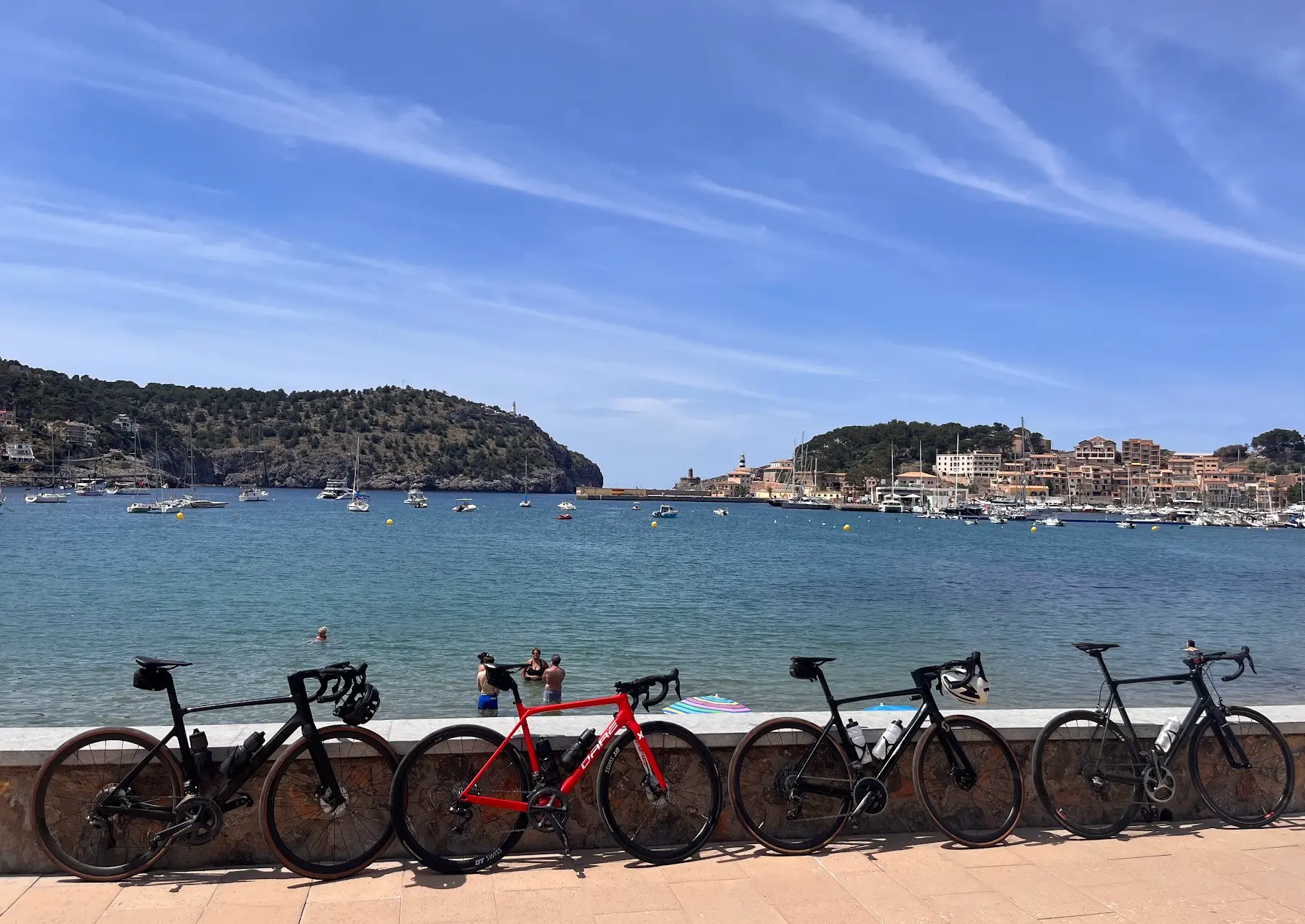
On my Mallorca trip I rode with Shimano Ultegra Di2, compact 50/34 chainrings and an 11-34 cassette. That gearing was right — no regrets on either climb. On Sa Calobra's last 3 km I had the gear I needed to keep spinning at a manageable cadence; on Puig Major's steady 6% I could sit in the middle of the cassette and ride rhythmically for an hour.
If I were starting from scratch for a Mallorca cycling holiday, 50/34 + 11-34 is what I would fit to the bike. Not 11-32 unless I was sure of my legs. Not 1× unless I was already on it. And definitely not 53/39, even on my best day.
Specialist setups
Triple chainring
If you have a triple (50/39/30 or similar), you're fine on anything Mallorca throws at you. The granny ring with a 28 or 32-tooth cog is overkill on most sections but comes into its own on Sa Calobra's final kilometres. The tradeoff is the extra weight and the chain line — modern electronic double setups with a 34/32 combination give you 95% of the benefit at less weight.
1× (single chainring)
1× systems (e.g. SRAM Red XPLR 1×13, Campagnolo Ekar 1×13) with a wide-range cassette (10-42, 10-44, 10-46 or 10-52) are excellent on Mallorca. The range is enough for Sa Calobra without the complexity of a front derailleur. The only downside is slightly larger cadence jumps between gears — noticeable on long steady climbs like Puig Major but not a problem.
E-bike
Modern road e-bikes are genuinely capable on Mallorca's climbs. If you have one and are riding it on holiday, don't overthink gearing — the motor solves the gradient problem. Focus instead on battery range and charging points, which is a different article.
Gearing you should not bring
Avoid any setup where your lowest gear gives you a ratio above roughly 1.1:1 (chainring teeth ÷ largest cog teeth). Examples: 39/28 is 1.39:1 — too high for Sa Calobra's last 3 km unless you are strong. 34/28 is 1.21:1 — marginal. 34/32 is 1.06:1 — fine. 34/34 is 1.0:1 — comfortable.
Renting versus bringing your own
Most rental shops in Mallorca (Alcúdia, Port de Pollença, Palma) offer compact or sub-compact gearing by default. If you're renting, confirm the cassette size when you book — the default on some hire bikes is 11-30 or 11-28, which is on the tight side for Sa Calobra. Ask specifically for 11-32 or 11-34. Most shops will swap the cassette for free or at minimal cost if requested in advance.
If you're bringing your own bike and your current cassette is 11-28, consider swapping to 11-32 or 11-34 before the trip. A €60 cassette is cheap insurance against a painful last 3 km on Sa Calobra.
Frequently asked questions
What is the easiest gear I need for Sa Calobra?
For most recreational cyclists, a 34-tooth front chainring paired with a 32- or 34-tooth rear cog is the minimum comfortable gearing. That gives you a ratio around 1.0–1.1:1, which lets you spin the steeper last 3 km at a reasonable cadence. Smaller ratios (e.g. 32-tooth front + 34-tooth rear on sub-compact) give more margin.
Can I cycle Sa Calobra with 50/34 and 11-28?
Yes, if you're a reasonably strong cyclist. The 34/28 ratio is 1.21:1 — tight but manageable on the 8–11% sustained sections near the top if your legs are good. If you're not sure, swap the cassette for an 11-32 or 11-34 before your trip. The cost is small, the difference on the last 3 km is large.
Is compact or sub-compact better for Mallorca?
Compact 50/34 is the mainstream choice and handles everything Mallorca offers with an 11-32 or 11-34 cassette. Sub-compact 48/32 gives you more margin on the steepest sections (Sa Calobra last 3 km, Cap de Formentor's final ramps) with only a small sacrifice on the flats. If you're choosing a new chainset and climb a lot, sub-compact is slightly preferable; if you already have compact, it's absolutely fine.
Will I need a triple chainring?
No. Triples are overkill for Mallorca's climbs. A compact double with an 11-34 cassette gives you a lower lowest-gear than most older triples did with their granny ring. Unless you already have a triple and are happy with it, there's no reason to fit one for Mallorca.
What gearing does Tommy use on Mallorca?
Shimano Ultegra Di2 with a compact 50/34 chainset and 11-34 cassette. That was right for both Sa Calobra and Puig Major — enough margin on Sa Calobra's last 3 km, plenty for Puig Major's steady 6%. No regrets on either climb.
Does a 1× drivetrain work on Mallorca?
Yes, and increasingly common. Modern 1×13 systems (SRAM XPLR, Campagnolo Ekar) with 10-42 or wider cassettes have the range for Sa Calobra. The larger cadence jumps between gears are slightly noticeable on steady climbs like Puig Major, but not a problem. If you already ride 1×, don't convert for Mallorca — it works fine.