Col de la MadeleineHC
- 19.26 km
- Length
- 7.9%
- Average
- 1,514 m
- Elevation gain
- 10.4%
- Steepest 500 m
- 1,990 m(GPX)
- Summit
The south side from La Chambre, 19 kilometres at almost eight per cent. The start is deceptive: you roll past orchards and through La Chambre before the D213 points upwards, and from there nothing eases until the top. The middle kilometres run through pine and beech woods, and above Saint François Longchamp the trees let go and you come out into open alpine pasture with the Mont Blanc massif on the horizon.
How long will Col de la Madeleine take you?
A rider at 3.0 W/kg takes about 107 minutes to climb Col de la Madeleine.
Put in your weight and the average power you hold on the gradient. We add 9 kg for bike and kit. The model works the time out from physics, and it has been tested against real rides.
Riders
The road
The D213 runs from La Chambre in the Maurienne over the pass and down to Notre-Dame-de-Briançon in the Tarentaise. The road opened in 1969 and is closed from November to May.
The sign at the top says 2,000 metres. That is rounded — the pass sits at 1,993.
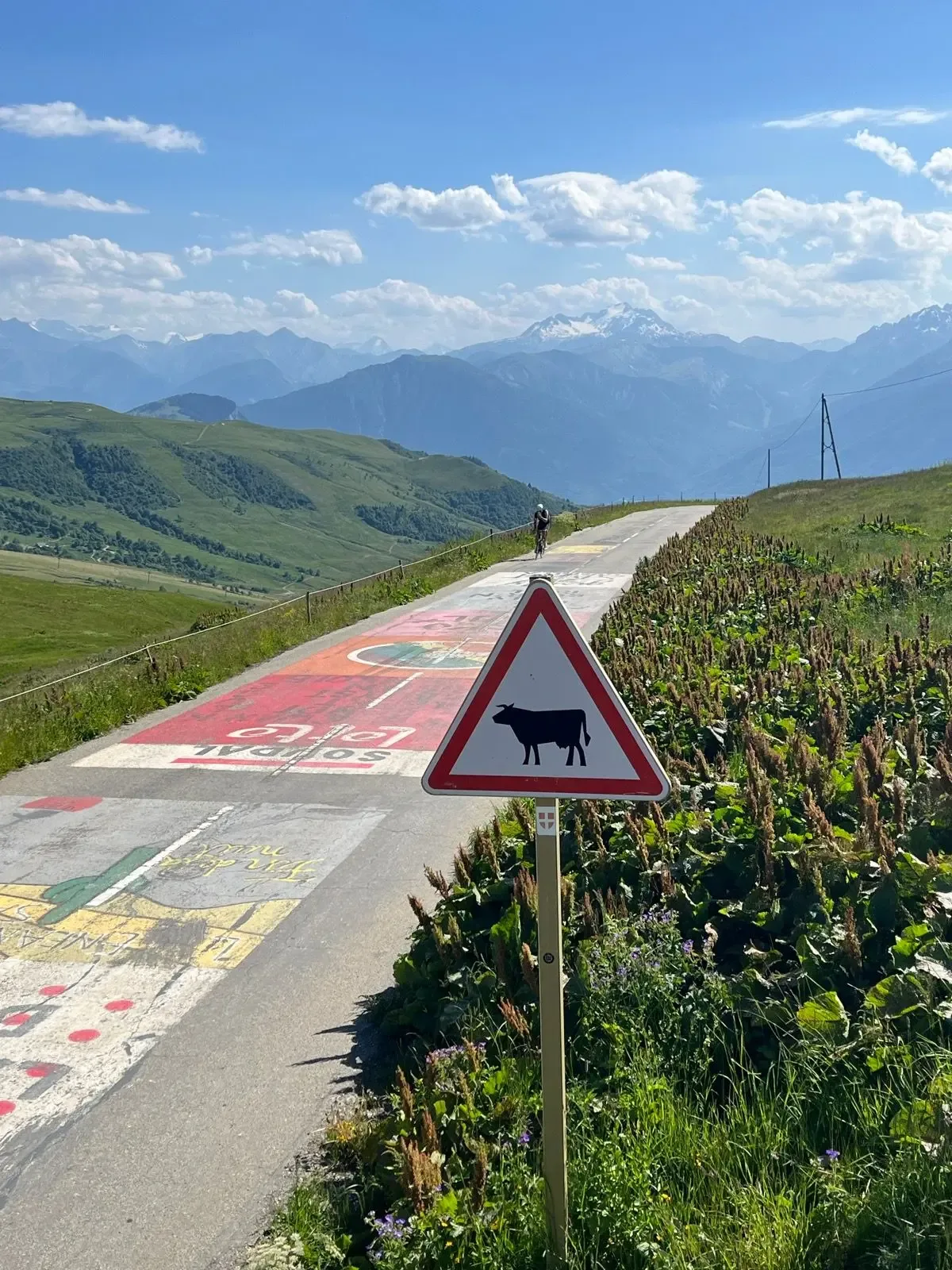
The tarmac on the last kilometres is painted with names from the professional peloton, and the big warning triangles on the road surface are there for a reason: the cows graze right up to the road behind electric fences. From the Panorama versant Tarentaise viewpoint you can see the Massif du Cheval Noir, the Massif de la Lauzière and Mont Blanc.
The climb
Only the first kilometre is gentle. From the second to the top the gradient sits between seven and nine and a half per cent, with not one flat section in between. The fourth, eighth and eleventh kilometres are the hardest, all around nine and a half per cent.
There is one place where it eases: the twelfth kilometre drops to six per cent. That is the only break on the climb, and it is over in a few minutes.
The woods hold the heat in the lower half. Saint Martin sur la Chambre and further up towards Saint François Longchamp are the last places with a café and proper water before it opens out — there are fountains along the way if you look for them. The last kilometres to the pass are exposed, with no shade, and there is nothing left up there to hide behind.