Region at a glance
All Routes in Costa Tropical
1 handpicked road-cycling routes in Costa Tropical.
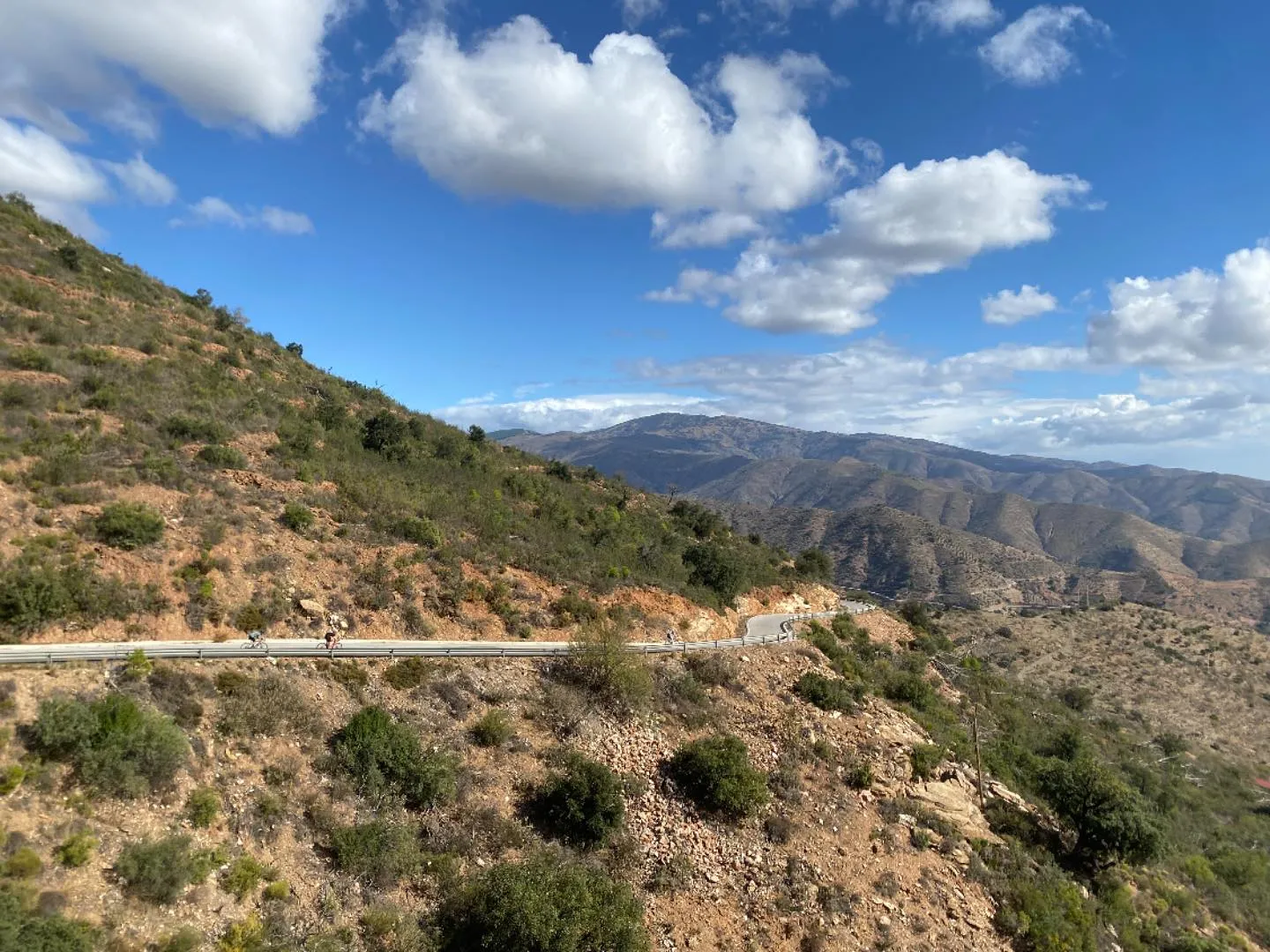
Costa Tropical is the coast of Granada province — 18 municipalities and just under 790 square kilometres between Nerja in the west and Adra in the east. The name comes from what grows here. Cherimoya, avocado, mango and guava stand on the terraces running down to the sea, in a microclimate where the Sierra Nevada blocks the north wind and frost never arrives. Straight behind the plantations, the Sierra de la Contraviesa and the Sierra de Lújar rise out of the Mediterranean to well over 1,500 metres. From the sea at Albuñol to the pass at Haza del Lino is 21.5 kilometres of road and 1,100 metres of climbing.
Read the full guide ↓Show less ↑
Compared with the coasts further west, this is a quieter place to ride. The mountain roads into the Contraviesa are narrow and silent, and you rarely share them with anyone. Costa Blanca and Mallorca have the denser cycling infrastructure — more workshops, and more cafés used to people in cycling shoes. Here the climbs are the reason to come, and you mostly have them to yourself.
When to go
The season is long. From October through April the coast sits at 17–19 degrees by day and 10–12 at night, and the area gets over 3,000 hours of sunshine a year. It rains little — around 500 millimetres a year, and in Motril, the largest town on the coast, only 379.
Those numbers are for the coast, though. Haza del Lino sits at nearly 1,300 metres, and the summit of the Sierra de Lújar at 1,870. Up there it is easily 8–10 degrees colder, and in January and February there can be snow on the highest ground. Pack a wind jacket and arm warmers even when the thermometer down by the sea reads 18.
May and June are fine if you start early. July and August are too hot for climbing.
Where to stay
Almuñécar and Salobreña in the west are the two natural bases. Both have hotels, shops and places to eat year-round, and Salobreña has signposted ten cycling routes from the town, with maps and elevation profiles. From here the Cabra road up past Otívar is the big ride.
If you want the Contraviesa climbs on the doorstep, the eastern end is where to go — Castell de Ferro, Gualchos, Albuñol. There are fewer beds and fewer places to eat, but you start the climb where others are still rolling out to it.
From Almuñécar it is around 90 kilometres to both Málaga and Granada airports, a little over an hour by car.
The climbs that define Costa Tropical
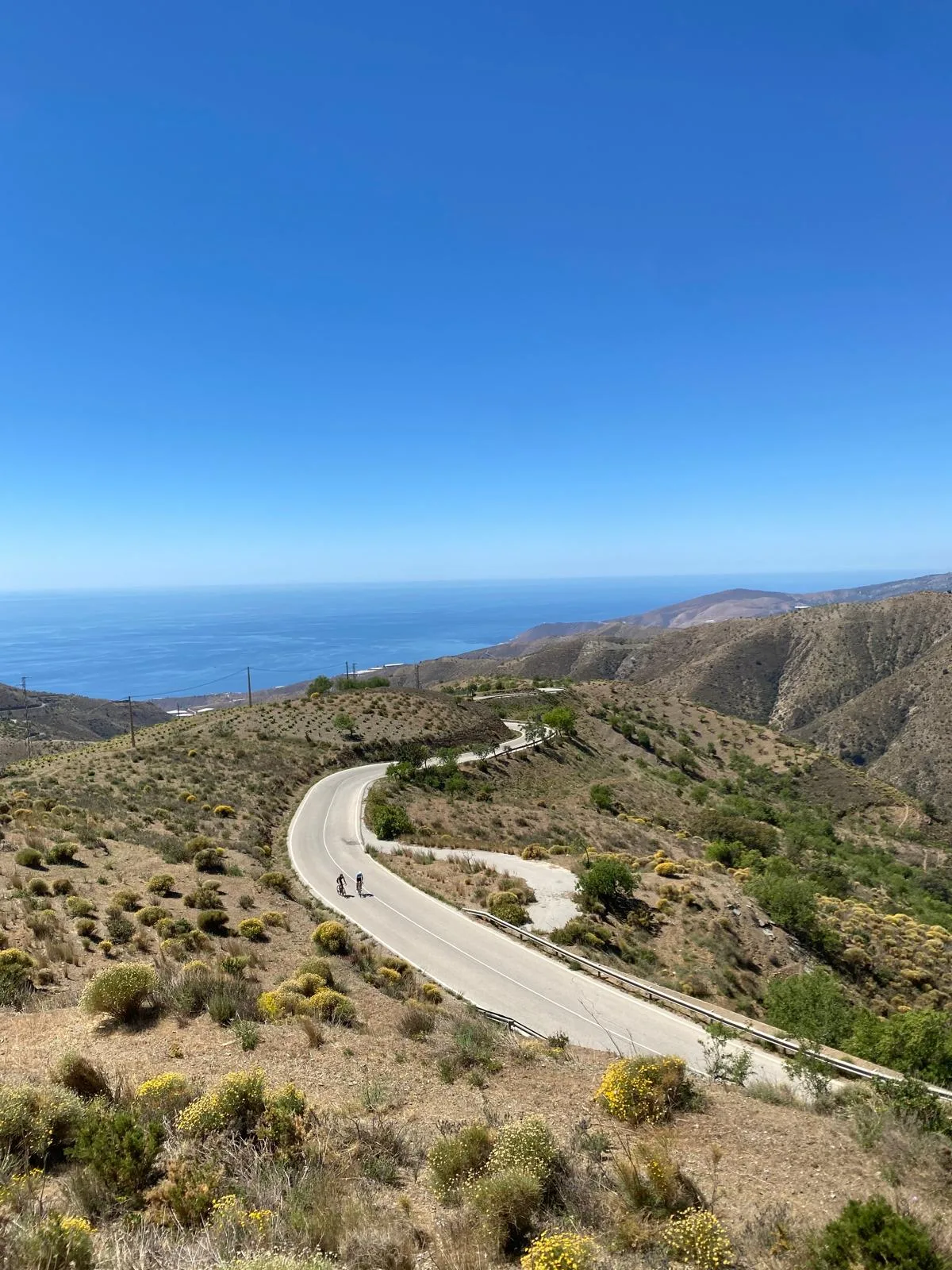
*Haza del Lino from Albuñol* is the region's big climb. 21.5 kilometres at 5.1% average up to the pass at nearly 1,300 metres, with fourteen hairpins on the way. It is long and steady rather than steep — the hardest hundred metres sits at 8.2% — so you get up on a moderate gear if you shift down early and hold the rhythm. The sea is behind you the whole way.
The pass can be reached from several sides. From Sorvilán the average is 6.8%. From Alfornón it is 23 kilometres at 6.4% with 18 hairpins and 1,469 metres of climbing, but that side has gravel sections, so check your tyres before choosing it.
*The Sierra de Lújar* is the other mountain, and the longest ride in the region. The mining road from Castell de Ferro runs 31.3 kilometres up to 1,870 metres at 6.3% average, with 37 hairpins — one of the longest continuous ascents in Spain. The surface is poor in places. How far up you go is your own call; the road is the same from the bottom.
*The Cabra road* from Almuñécar — Carretera de la Cabra, the A-4050 — is the classic ride in the west: up past Otívar to the Mirador de la Cabra Montés viewpoint at a little over 1,000 metres, and higher still beyond it. Salobreña's tourist office lists it as their hardest signposted route: 133 kilometres and 2,790 metres of climbing out and back.
Practical tips
The A-7 motorway only reaches Motril. East of the town the N-340 is the only coast road, and it carries all the traffic. Get up into the mountains as soon as you can.
Fill the bottles in the village before you start the climb. On the Contraviesa ridge the stops are far apart, and several of them close out of season.
There are two workshops worth knowing: Miranda Bike in Motril and Bike Store Nerja. East of Motril they are a long way apart, so carry a tube and patches.
The greenhouses shape the first few kilometres out of the towns. They disappear as soon as you start climbing.
Frequently asked questions
- When is the best time to cycle on the Costa Tropical?
- October through April. The coast sits at 17–19 degrees by day, and the area gets over 3,000 hours of sunshine a year. Remember the climbs reach 1,300–1,870 metres — up there it is 8–10 degrees colder, and snow is possible in January and February. May and June are fine if you start early. July and August are too hot.
- Where should I stay for cycling on the Costa Tropical?
- Almuñécar or Salobreña if you want hotels, shops and places to eat year-round — and the Cabra road up past Otívar right outside. Castell de Ferro, Gualchos or Albuñol if you want the Contraviesa climbs from the door. There are fewer beds in the east, but you skip the ride out. Both airports are around 90 kilometres from Almuñécar.
- What is the best climb on the Costa Tropical?
- Haza del Lino from Albuñol — 21.5 kilometres at 5.1% average from the sea up to nearly 1,300 metres, with fourteen hairpins. Long and steady, never brutal. If you want something harder, take the same pass from Alfornón: 23 kilometres at 6.4% with gravel sections. The Sierra de Lújar from Castell de Ferro is the longest, 31.3 kilometres to 1,870 metres.
- How does Costa Tropical cycling compare with Costa del Sol?
- The mountains stand closer to the sea and go higher. Peñas Blancas on the Costa del Sol tops out at 950 metres; here you climb to 1,300 on Haza del Lino and 1,870 on the Sierra de Lújar. Costa del Sol has more cycling infrastructure in return. Costa Tropical has very little — and correspondingly little traffic on the mountain roads.
- Do I need low gears for the climbs on the Costa Tropical?
- A compact 50/34 up front and 11–32 at the back is enough for Haza del Lino from Albuñol and for the Cabra road. Both are long and steady rather than steep. For the Alfornón side and for the mining road up the Sierra de Lújar you want 11–34 or lower — there it is the length and the surface that cost, not the gradient.