Col de BrausCat 3
- 9.8 km
- Length
- 6.4%
- Average
- 629 m
- Elevation gain
- 9.7%
- Steepest 500 m
- 999 m(GPX)
- Summit
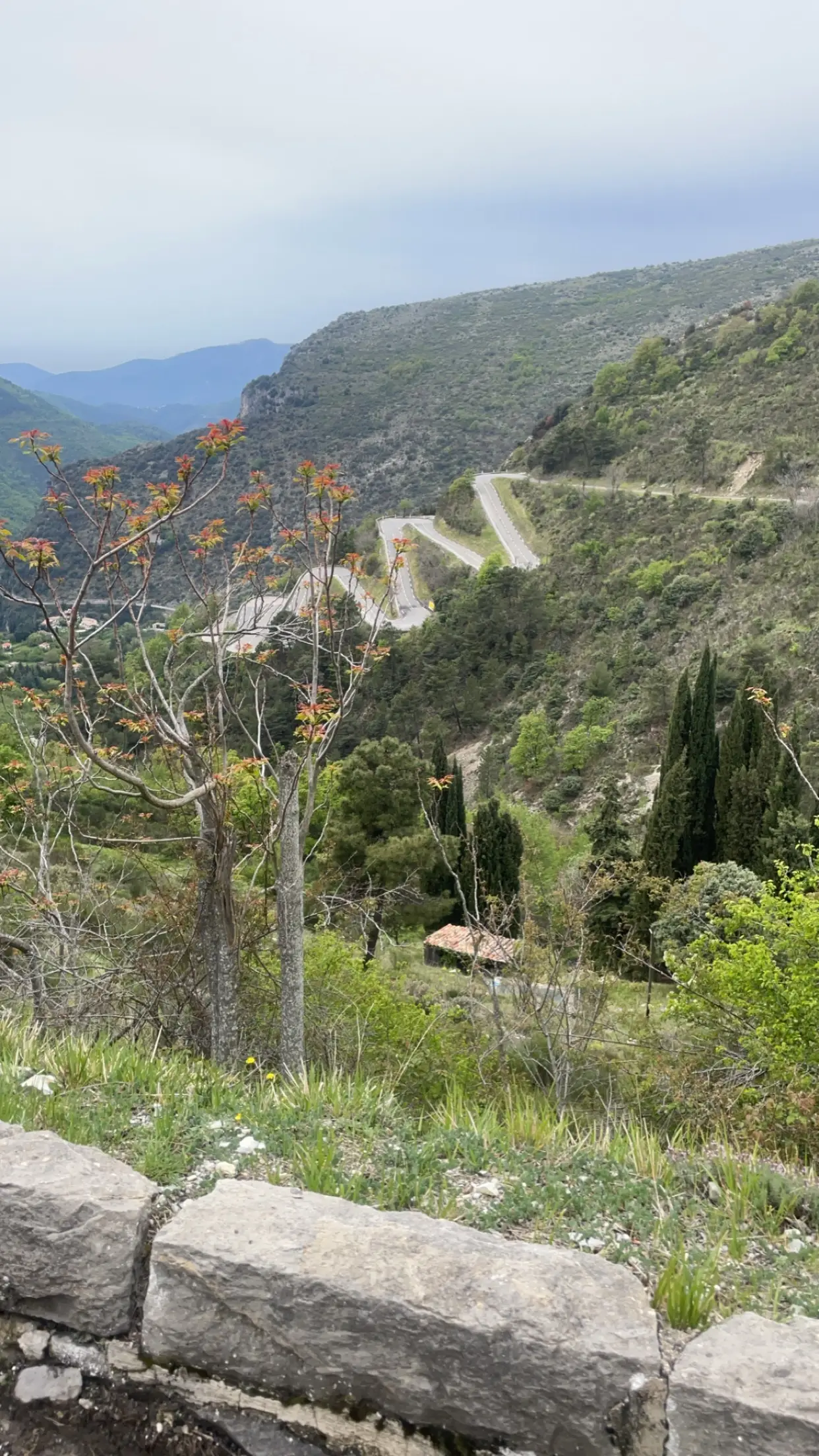
Braus climbs straight out of L'Escarène, and the hardest stretch on the whole climb comes early, around the third kilometre. Then comes a noticeably easier kilometre where you can get your breath back. The rest is hairpins, around twenty of them. They are at their tightest between the fifth and eighth kilometres, where the road folds up the hillside so that you can see the stretch you have just ridden directly below you. On the retaining walls in the bends there are pictures and text about the Tour de France, which last came through in 2024. Right at the top it straightens out again, and the last kilometres are among the steepest on the climb.
How long will Col de Braus take you?
A rider at 3.0 W/kg takes about 46 minutes to climb Col de Braus.
Put in your weight and the average power you hold on the gradient. We add 9 kg for bike and kit. The model works the time out from physics, and it has been tested against real rides.
Riders
The road
The stacked hairpins rest on retaining walls built in the early twentieth century. It is that engineering that lets the road fold so tightly on such a steep hillside.
The Tour de France has crossed the pass 28 times, first in 1911 and most recently in 2024, when stage 20 left Nice and took Braus before Turini. At the top there is a memorial stone to René Vietto, who was first over here in 1934.
Braus is also the way in to Turini. The Monte Carlo Rally uses it as the approach to the night stage, and leaves rubber marks in the bends.
The climb
The first two kilometres out of L'Escarène are manageable. Then comes the third kilometre, the hardest on the whole climb, with half a kilometre of it measuring 9.5 per cent.
The fourth kilometre is the opposite. The road runs straight and the gradient drops to a little over four per cent, and it is the only place you really get to breathe.
From there the hairpins start. The next four kilometres sit between six and seven and a half per cent, and the bends come thick and fast. Turn round and you can see the road stacked in layers below you, and L'Escarène down in the valley.
The last kilometre straightens out and holds a little over seven per cent to the pass.